
Swami Bodhananda
Messages from Swami Bodhananda
New Year and festival messages, reflections on our times, and words of wisdom from our Guru.
WhatsApp channel
Advaita Teachings of Swami Bodhananda
The WhatsApp channel of Sambodh Foundation and The Sambodh Society Inc. Follow it to receive Swami Bodhananda’s teachings on your phone.
Deepavali 2026 · A message from Swami Bodhananda
What is the significance of the Deepavali festival?
As the earth spins on its imaginary axis as usual, ushering in the month of Aswini, the people inhabiting the region between the Hindukush and the Arakhan, from Kanyakumari to Kashmir, prepare themselves to celebrate Diwali, the festival of lights. Light has a special meaning and significance in human life. A devout traditional Hindu tends a permanent fire in his house. A modern Hindu keeps a lamp or a zero-watt bulb burning in their pooja room.
The Lord, the Self of all beings, is of the nature of light — Jyotisvaroopah. The early Vedic Rishis chanted: lead from darkness to light, from death to deathlessness. The ultimate reality, the consciousness, the Brahman, is pure light. It is in the light of that consciousness that everything that falls in the field of experience, including the sun and the moon, is illumined. He alone shines in his resplendent glory, and everything else shines after him.
— Swami Bodhananda
Happy Deepavali! May the light within shine in every home and every heart.
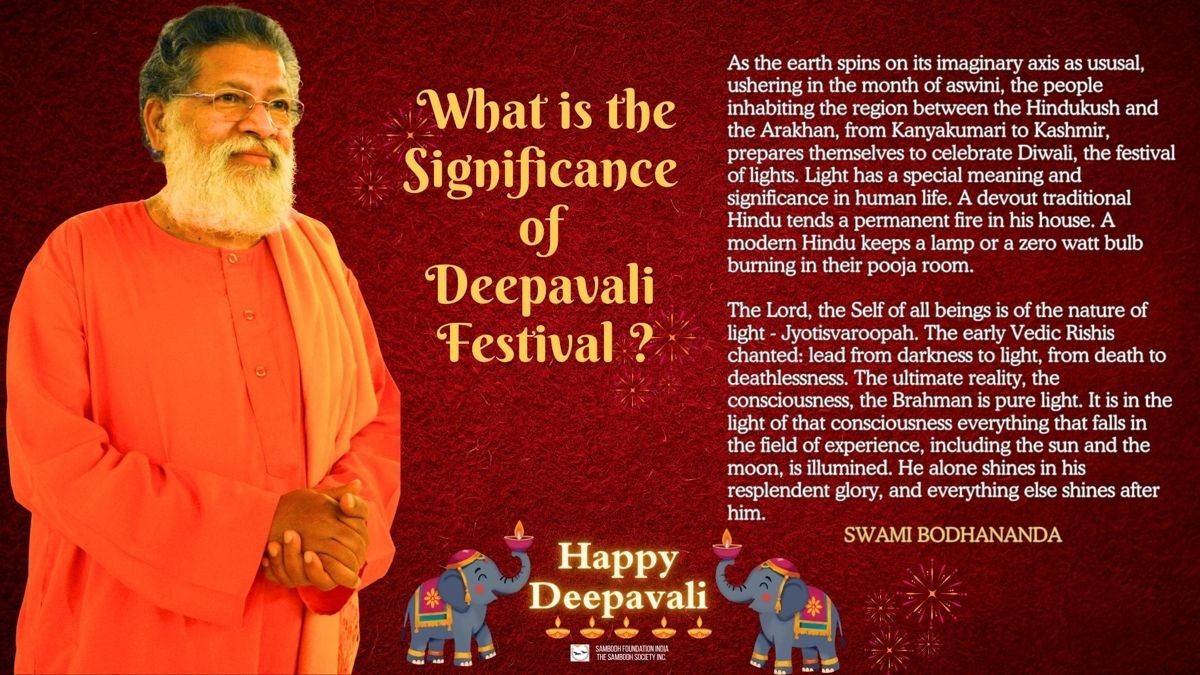
Dīpāvali message · 2025
The garland of lights
Diwali, the garland of lights, is the most important festival of Hindus. The whole of India, regardless of their differing faiths, languages and customs, enthusiastically participates in this national celebration. Mythologically, Diwali is an enactment of a rousing welcome accorded to Lord Rama, Ma Sita, the heroic Lakshmana and the super achiever Hanuman by the citizens of Ayodhya, the city of peace, on their return after the epic victory over the ten-headed demon Ravana.
Symbolically, Diwali is the divine assurance of the ultimate triumph of good over evil, truth over untruth and life over death. The fireworks that explode from every household and neighborhood on this day express people’s happiness and the hope that good days are on the horizon, and that the dawn of peace, prosperity and freedom from want is not far away.
Let us also rejoice and sing the glory of Lord Rama, the epitome of Dharma, and elevate ourselves spiritually on this most auspicious occasion of Diwali.
Hari Om Tat Sat — Swami Bodhananda
Navaratri message · 2023
The nine nights of Devi
This festival of nine days is a reenactment of Devi Durga’s epic fight with several demons and their chief Mahishasura — a fight that lasted for nine days, and the tenth day celebrated as the day of final victory.
The demons are Madhu (the sweet-speaking), Kaitabha (the deceitful), Chanda (the horrible), Munda (the secretive), Raktabija (the blood-sucker), Dhumraksha (the fierce-eyed), Sumbha (the wretched) and Nisumbha (the miserable). They also represent the vices — lust, greed, envy, hate, anger, violence, sloth and gluttony. Mahishasura represents vanity and pride. All these vices are the broods of a primeval avidya, or ignorance — ignoring the whole while preoccupied with the part.
Durga is the combined power of Brahma, Vishnu and Shiva, and is composed of Jnana Shakti (knowledge power), Kriya Shakti (action power) and Iccha Shakti (will power), also represented by Sarasvati, Lakshmi and Kali.
Durga, astride a lion, holding eighteen weapons in her eighteen hands, descends like a thunderbolt, the lion’s roar sending shock waves through the citadel of evil, awaking the gluttonous demons to their terrible end. Durga by a mere look could destroy most demons, and had to fight for nine days with Mahishasura to claim final victory.
The subjective and psychological meaning of this mythical narrative is that all these demons populate our minds, all along the spinal column, concentrated on the chakras. You may call them negative energies — which can be converted to positive energies through yogic discipline: asana, pranayama, pratyahara, upasana and so on.
— Swami Bodhananda
No virus can affect the brave, bold and self-abiding, whose immunity is high. Therefore don’t worry! Even if your immunity is low, worrying only depletes it further. Therefore don’t worry.— Swami Bodhananda, March 2020
Failure is not a problem; lack of effort is the problem. When you make one step forward, God takes ten steps towards you.— Words of wisdom
Possessiveness comes from a sense of inadequacy.— Swami Bodhananda, on Shiva
Read Swami Bodhananda’s article on Shiva (PDF) →
Guru: The Moonlight of Wisdom
A collection of the messages Swami Bodhananda has written for Guru Purnima over the years, released on Vyasa Purnima, 21 July 2024. Through them he shares the moonlight of his wisdom, and the significance of Sri Veda Vyasa.
Kindle editionMessages & reflections
Swami Bodhananda’s blog →- 3 November 2026Consciousness in the MachineReflection
- 27 October 2026We Are a Network of I-sReflection
- 10 October 2026Where Does Happiness Come From?Reflection
- 2 September 2026Can We Build a Moral Machine?Reflection
- 20 August 2026History, Power and the Next Fifty YearsReflection
- 15 August 2026The Second Axial AgeReflection
- 10 August 2026The Axial AgeReflection
- 23 June 2025Walking Back from the BrinkReflection
- 2 August 2024Limits of the Hindutva IdeologyReflection
- 29 March 2020COVID-19 — Govindam Bhaja Mudhamate!Reflection
Stay with the Inner! Away from the Outer!
Swami Bodhananda’s daily messages during the first weeks of the pandemic, spring 2020. Click a message to read it full size.
More from Gurudev
Swami Bodhananda’s essays, talks and travelogues in our library, and his reflections on the Sambodh India blog.
Stay connected
Subscribe to Sambodh newsletters for Swami Bodhananda’s messages, festival greetings and program announcements.
The button opens a ready-made email in Outlook, Apple Mail or your usual email program. Add your name and city, and send it. If nothing opens, write to sambodh.international@gmail.com with the subject “Subscribe”.
Write to Sambodh
Got a question or feedback? Wish to write to Swami Bodhananda, invite him to your city, or offer seva? We’d love to hear from you.