
About
16 things to know about the Sambodh Society
Questions and answers on the Society, Advaita Vedanta, practice and the background of the tradition.

The Sambodh Society
1What is the Sambodh Society?
It is a non-profit religious organization, registered in the State of Michigan in 1998 and tax-exempt in the United States, with Swami Bodhananda as its President. The Society has its headquarters in Kalamazoo, Michigan, and a presence in many states and major cities, including New York, Washington, New Jersey, Columbus (OH), Atlanta, Houston, San Antonio, St. Louis, San Francisco, Los Angeles and Seattle. In India, Sambodh has organizations in Bangalore, Ahmedabad, Trivandrum, Kochi, Kozhikode, Palakkad and Nagercoil, with its headquarters in New Delhi.
2What are the Sambodh Society’s objectives?
There are three:
- To communicate the vision of Universal Oneness, or Advaita Vedanta, through the teaching of the Bhagavad Gita, the ten principal Upanishads and the Brahma Sutras, as well as other associated texts, as interpreted by Jagad Guru Sri Adi Shankaracharya.
- To organize, encourage and inspire people to understand the place of ritual and to simplify its form, to pray, and to meditate.
- To activate the inner spiritual power of individuals through instruction in meditation, and to channel that meditative energy into humanitarian and charitable activities.
3How does Sambodh propose to realize these objectives?
By establishing teaching and retreat centers (ashrams); training and instituting an order of dedicated teachers; publishing aural, written and electronic media; and organizing retreats, seminars, dialogues (including interfaith dialogues), workshops, mass rituals, prayer and meditation.
Advaita Vedanta
4What is Advaita Vedanta?
Advaita means “non-dual”; Vedanta means “ultimate knowledge.” Advaita Vedanta is the teaching that all forms of existence are one integral web, a manifestation of the underlying Consciousness, which can be realized in a pure, meditative mind. This is expressed in such Upanishadic statements as “All that is, is Brahman” and “That Brahman is none other than the individual Self.”
5How does this knowledge help me in my daily life?
Our daily life is full of strife and struggle; we often get confused as to what is right and wrong. In lonely moments we wonder about the world, our place in it and our destiny. “Who am I?” is a puzzling question that assails the mind as we contemplate our inevitable mortality. Like a dry leaf in a storm, we shake in fear, uncertain about the future. The study of Vedanta gives the spiritual seeker clarity about duty and moral choices, as well as about the true nature of his or her personhood.
6How does the study and knowledge of Advaita Vedanta give me clarity?
Vedanta teaches that one has to live in this world by doing honest, hard work — not by exploiting others for one’s own sake, but by drawing energy, purpose, motivation and happiness from one’s own self. The purpose of life is to realize one’s potential through a balanced mind while interacting with an ever-changing world.
“All that is, is Brahman” — and that Brahman is none other than the individual Self.
Practice
7What is Sambodh’s view of idol worship (murti puja) found in traditional Hindu practice?
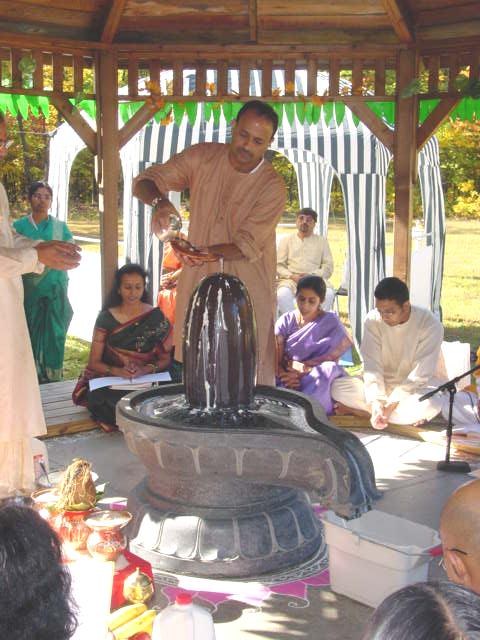
A Hindu believes that there is only one Supreme Truth, but many manifestations of divinity and many paths to God. So the correct notion is “ideal worship” rather than idol worship — worshipping the ideal represented by the murti. There are six primary deities that Hindus worship in the form of murtis: Surya, Ganesha, Skanda, Vishnu, Shiva and Shakti. Hindus also worship different conceptions or manifestations of these deities — for example Rama, Krishna, Hanuman, Durga and Kali. All these deities are manifestations of that same Supreme Power, which we call Brahman. Every Sambodh center in India has installed a Ganesha murti, while the Michigan headquarters of Sambodh in America has installed a Shiva–Shakti murti.
8What is a cult, and how does the Sambodh Society differ from this type of organization?
According to Webster’s dictionary, the word “cult” is derived from two Latin roots, cultus (“care” or “cultivation”) and colere (“to till” or “to cultivate”). From these comes the idea of a system of religious worship or ritual. The word can mean worship, religious rituals, or devoted attachment to a person or a principle, and is often associated with faddism.
The Sambodh Society is a fellowship of worshippers who cultivate certain ideals embedded in deeply rooted, ancient spiritual principles — which distinguishes it significantly from faddism or cultism. In its commitment to the vision of Universal Oneness implicit in Vedantic philosophy, the organization is inclusive, incorporating rituals derived from many traditions. Under the spiritual guidance of Swami Bodhananda Sarasvati, his precursors and successors, the Society respects the tradition of scriptures and gurus interpreted and symbolized in India’s monastic Advaita Vedanta tradition. It is not a cult, because it does not blindly accept spiritual leadership without a tradition of scriptural or moral discipline. A basic tenet of the Society is respect for universal human values, the law of the land, and the dignity of the individual.
9What about other religions and sects, in India and elsewhere?
Vedanta teaches that all religions are capable of leading humanity on the path of righteousness and truth. Major religions have sects and sub-sects that reflect differences in human tastes and inclinations. Vedanta also teaches that dialogue, debate, interaction and sharing among followers of different religions and sects are to be encouraged, in a spirit of mutual respect for difference.
10What is Sambodh’s view of interfaith dialogue?
The purpose of dialogue ought to be to create a new level of spiritual awareness in the global eco-context. We therefore encourage intellectual, theological and philosophical input in such dialogues, along with intellectual and spiritual honesty — without clinging or becoming entrenched.
Vedanta teaches that all religions are capable of leading humanity on the path of righteousness and truth.
Background
11Who are the foremost teachers of Hindu culture and religion?
Veda Vyasa (traditionally dated to 3000 BCE) and Sri Adi Shankaracharya (8th century CE).
12Briefly tell me about Sri Shankaracharya.
He is the foremost proponent of Advaita Vedanta. He was born in the village of Kalady in Kerala in 788 CE, and passed away in the Himalayas at the young age of 32, in 820 CE. He was a master of the four Vedas, the ten principal Upanishads, the Brahma Sutras (aphorisms by Badarayana harmonizing the Upanishads), the Puranas (collections of ancient stories containing ethical and religious principles), the itihasas (epics) and the darshanas (the six systems of orthodox Hindu philosophy).
In the 8th century, Shankaracharya restored Hinduism in India and brought diverse Hindu faiths under one umbrella. He reformed and simplified Hindu rituals, determined the basic Hindu canon and wrote commentaries on each canonical scripture, established an order of monks to practise and teach the scriptures, and fought against the evil practices perpetrated in the name of religion. Shankara was his given name; acharya is an honorific meaning “one who lives what he teaches.”
13What are the Vedas?
The Vedas are the revealed wisdom of the Hindu people. The four Vedas — the Rig Veda, Yajur Veda, Sama Veda and Atharva Veda — are hymns addressed to many gods, chief among them Indra. The oldest, the Rig Veda, contains more than a thousand hymns, the most famous being the Gayatri mantra, the Purusha Sukta and the Nasadiya Sukta. Even today, students chant the Gayatri mantra to develop the powers of the mind. The Purusha Sukta is a hymn addressed to God, envisaging Him as the transcendental, manifest Reality; the Nasadiya Sukta casts doubt upon the human ability to “know” God.
The Yajur Veda mainly contains instructions for ritual. The Sama Veda is a set of Rig Vedic hymns arranged for singing. The Atharva Veda contains incantations, chants and rituals to ward off evil, as well as knowledge of music, architecture, archery, medicine, politics and other aspects of social life. Hindus accept the four Vedas as the foundational wisdom of their religious traditions.
14Explain mantra.
A mantra is a Vedic sound formulation, or “vibration,” which a guru may prescribe to disciples for chanting. Typically the student meditates upon a specific deity while chanting the mantra. Chanting a mantra strengthens the student’s devotion to the deity and to the guru, and their study and pursuit of Truth (Brahman).
15What are the Upanishads?
The Upanishads are the final teachings of the Vedas, found at the end of each. There are ten principal Upanishads studied in Vedanta — those with commentaries by Shankaracharya: Isha, Kena, Katha, Prashna, Mundaka, Mandukya, Taittiriya, Aitareya, Chandogya and Brihadaranyaka. They contain incisive, in-depth reflections on three fundamental human preoccupations: the individual self, the phenomenal world, and the transcendental God. Their realized conclusion is that these three are expressions of the same Truth. The Sanskrit word for the ultimate truth is Brahman or Sat; for the individual self, Atman or Chit.
The four celebrated Upanishadic proclamations (mahavakyas) to be realized may be stated, in order, as:
- That thou art.
- Truth is pure Consciousness.
- The individual self is the Truth.
- I, indeed, am Truth (pure Consciousness).
16What are the Brahma Sutras?
They are a set of 537 pithy formulations about Brahman, the Ultimate Truth, composed by the sage Veda Vyasa and commented upon by Sri Shankaracharya. The sutras are a set of logical expositions of the mystical statements of the Upanishads.
From the Sambodh Society’s leaflet 16 Things to Know about The Sambodh Society (2006).